
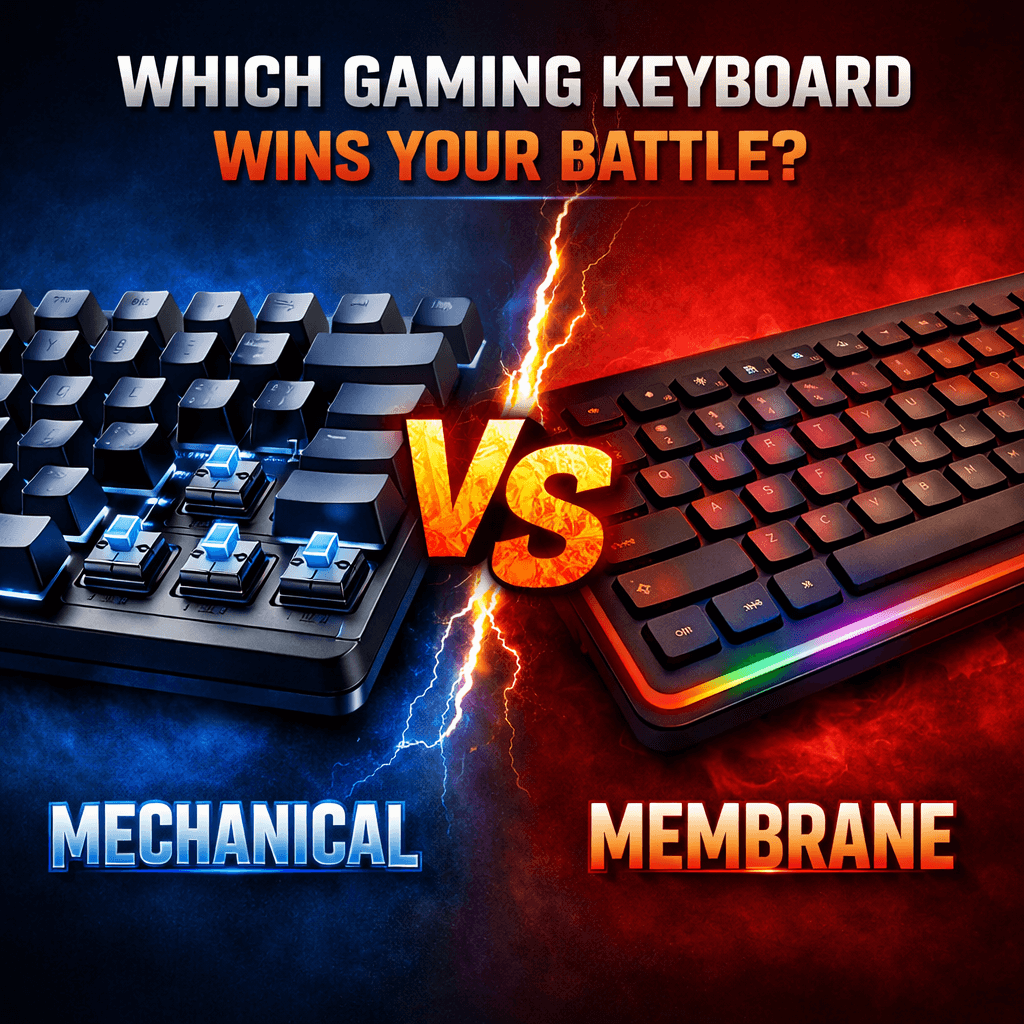
I own a gaming laptop and was able to buy the one that works the best only recently. And that’s when I realised owning a perfect gaming keyboard is equally important. Now, one question that stuck around was whether a mechanical one was better or a membrane one? So I thought of asking my senior gaming friends, but each one had their own opinion, and I was confused. Some swore that mechanical keyboards had changed their lives. Others insisted that membrane keyboards are quieter, cheaper, and just fine. But I realised that the truth, as usual, lies somewhere in between.
Like me, if you have ever wondered which keyboard actually sits well for your gaming style, budget, and setup, I think this guide will really help you make the right choice. So stick around.
Understand the Basics Of Mechanical vs Membrane Keyboards
Before choosing sides, let us get a clear picture of what separates mechanical and membrane keyboards in the first place.
A mechanical keyboard uses individual mechanical switches under every key. Each switch has moving parts, usually a stem, spring, and housing, nothing that you’d be bothered about, but it’s good to know, and it registers every keystroke with precision. These switches come in different types: linear, tactile, and clicky, offering a distinct feel and sound. This is why mechanical keyboards feel more “alive” and responsive compared to regular keyboards.
On the other hand, a membrane keyboard uses a single rubber or silicone layer beneath the keys. When you press a key, it pushes the membrane down to complete a circuit. Remember the feel of the first Nokia phone, where all the keys were blended? A membrane keyboard feels something similar. Most laptops and budget keyboards use this technology. It’s quieter, softer, and far cheaper to manufacture, but it also feels very different.
Performance: Does One Actually Make You Play Better?
Let me stop you and tell you right here that a mechanical keyboard won’t make you a pro-gamer overnight! But it can improve consistency, comfort, and reaction over time. According to me, mechanical ones work better because they offer faster and more consistent key actuation, better feedback: you know exactly when a key is pressed, and support advanced features like N-key rollover and anti-ghosting. And, in fast-paced games like FPS titles, MOBAs, or battle royales, that reliability does matter.
But I also wanted to use a membrane keyboard just to be sure, and that is exactly what I did. I borrowed a friend’s for a month and checked for myself. They can handle gaming just fine, especially for casual players. Modern membrane keyboards have improved a lot and often include gaming features like backlighting and anti-ghosting. However, key presses feel less precise, the actuation force varies over time, and missed inputs are more common in intense scenarios, which is something that puts me off.
Typing Feel: The Real Deal-Breaker
Now, the only reason you’d find yourself preferring a membrane keyboard over mechanical ones is because of the typing noise that mechanical ones cause. If you are looking for a keyboard that’d make zero or little noise while you passionately press those keys, go for membrane keyboards. Membrane keyboards are mushy, cushioned and offer low-resistance and hence, may feel comfortable.
Sound: Clicks vs Silence
If you share a room like me, then the amount of sound your keyboard makes is an important factor that you may want to consider.
While mechanical keyboards are factually louder, especially during key switches, noticeable on voice calls, and may be distracting to others, linear and silent switches come with a membrane keyboard. So consider your choice accordingly. They are naturally quiet, ideal for shared spaces, and less intrusive during late-night gaming sessions.
Durability: Built to Last or Built to Replace?
Mechanical switches are designed to last 50-100 million keystrokes per key. Let me do the calculation for you! This means you get years of heavy gaming, minimal performance degradation, and keys that feel consistent even after long use. They are a long-term investment. Now, if you evaluate a membrane keyboard on that same parameter, they may usually last up to 5-10 million keystrokes per key. That is 90% less. Keys start to feel softer, responsiveness drops, and certain keys might just pop or stop registering. They are fragile and not for long-term usage.
Price: The Deciding Factor for Many Gamers
Many of us are often still dependent on our parents’ income while we are in our initial gaming phase. Hence, this one is the most crucial among all considerations. Obviously, by now, you’d know that mechanical keyboards are more expensive ones. They offer complex, but durable mechanisms which cost more, have higher build quality, and allow customization options if you need fancy, flashy ones. Entry-level models may still be affordable, but premium ones cost a bomb.
On the other hand, membrane keyboards are comparatively affordable, widely available, and are often bundled with gaming PCs. So if you are a gamer, but on a tight budget, go for a membrane keyboard.
Final Verdict: There Is No Universal Winner
See! Now you understand why, at the start, I told you that the truth about mechanical keyboards being better than a membrane keyboard and vice versa lies somewhere in between. There is no single winner here. The best one is the one that fits your needs and budget. Sure, mechanical ones dominate performance, durability, and customizations, but membrane keyboards are preferred when affordability, quietness of operation, and simplicity are in question.
If gaming is a serious hobby or passion, mechanical keyboards are worth the investment. If gaming is a way to relax after work or college, a good membrane keyboard can serve you perfectly well. At the end of the day, skill comes from practice, and not from the keyboard. But choosing the right one can make every battle feel just a little smoother.
Disclaimer: The content on this blog is for informational and educational purposes only. While we aim to provide accurate information, we can’t guarantee its completeness or accuracy. The views expressed are those of the authors and may not reflect those of the blog.