
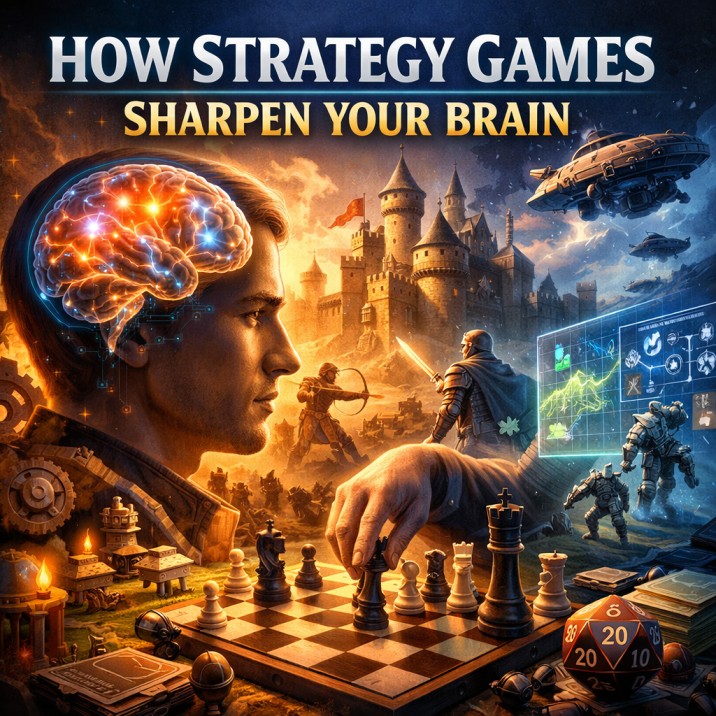
To date, many think gaming is a distraction. Something that numbs the mind and restricts the thinking ability. But surprisingly, that is not true. Anyone who has spent hours planning the perfect game plan, managing limited resources or locked rewards, or even outsmarting a human opponent, knows the truth: some games don’t just entertain, they train, too. Gaming demands intense mental ability for real-time strategy classics to modern epics and city builders. They challenge the players to think ahead of time, analyze situations, remember too much information and use it when it’s time, multitask, adapt to changing conditions, and manage complex situations. It also helps gamers to focus, keep calm in panic situations, perform under stressful situations, and survive in adversities. Now tell me, aren’t these skills that we all need?
Why Strategy Games Are Different From Other Games
We have highlighted the importance of puzzles in our previous articles, and now it is time we look at what strategy games have to offer. Most of the games feed on reaction speed, hand-eye coordination, and recognizing pattern repetition. But contrary to this, strategy games slow the pace just enough to make thinking unavoidable. There are no reflexes at play, nor are there trained brain cells. Players are needed to carefully analyze the situations with whatever information they have, balance short-term gains against long-term goals, predict opponents’ actions, recover from mistakes, and optimize use of resources to survive. This constant need for mental engagement activates higher-order cognitive processes in the brain. And the result? A strengthened brain that does not stress anymore.
Strategic Thinking: Learning to Think Several Moves Ahead
Don’t we all need strategic thinking skills to run our lives smoothly, too? In the gaming world, too, strategic thinking is the heart of every game. Foresight is equally important while playing just as much as it is in real life. There is no denying that. So whether you are planning an expansion in a real-time strategy game, managing turns in a tactics game, or setting policies in a simulation, you will always find yourself asking: What happens next? This forward thinking that gets developed trains planning ability, anticipation, and consequence awareness. Gamers learn from the very beginning that actions have consequences. It causes a ripple effect. And hence, they move carefully. This habit soon gets absorbed by them and starts to reflect in their real lives, too. They are often people who are street-smart and know how to tackle their problems.
Resource Management and Mental Discipline
You’d never see a gamer waste resources that they have. They very well know what is useful to them, and more often than not, use their resources in the best possible manner. And soon, this habit is seen in the way they function in their day-to-day lives, too. The essence of a strategy-based game is scarcity. You’d never have unlimited resources in these kinds of games. Hence, managing these systems strengthens prioritization skills, cost-benefit analysis, and risk assessment. Gamers learn to understand the worth of their resources and use them wisely. This mental discipline also gets carried into their real life, improving budgeting, planning, and project management skills.
Decision-Making Under Pressure
Let’s be honest, we all must have failed sometimes or another because of the poor decision we took while under pressure, didn’t we? Strategy games often build pressure where you will have time to think, but not enough to start overthinking. And that is a quality that most of us lack. Sticking to deadlines and coming up with solutions in a specific time frame. This controlled pressure environment trains the brain to stay calm while evaluating options, avoid panic decisions, and commit confidently to a plan. And unlike reflex-based games, strategy games reward composure. These players learn to be thoughtful and wise.
Pattern Recognition and System Thinking
These games are often built on systems like economic loops, tech trees, combat formulas, and AI behaviours. And to succeed, the player must be capable of understanding how these systems interact. And, this, in any manner, is not child’s play. Strategy games are known to strengthen pattern recognition, systematic thinking, and analytical reasoning. So instead of focusing on solo, isolated actions, players learn to see the bigger picture, which is often missed by people in real life. They learn to understand how multiple elements influence each other. These show how they understand relationship dynamics in their real life and know how actions impact the other differently.
Multiplayer Strategy: Outsmarting Humans
Things get better when strategy games involve multiple players. With that, the cognitive challenges multiply. You are no longer standing against an AI version that you can outsmart with human tactics. You are against another human, and that makes everything so much more interesting. You are no longer solving puzzles and decoding grids; you are now reading human minds. The sound of it makes things so much more interesting, doesn’t it? Multiplayer games sharpen social reasoning, prediction and bluffing, and increase psychological awareness. Players learn to think probabilistically, anticipating not just what seems to be optimal, but also what an opponent may believe to be optimal.
Play Smarter, Think Sharper
Strategy games are ones that really pique my interest from time to time and make me obsessed. It challenges us to think ahead, manage complexities, and adapt under pressure, and helps sharpen the mind in humanly impossible ways. Whether you’re commanding armies, building civilizations, or optimizing resources, you’re doing more than playing.
Disclaimer: The content on this blog is for informational and educational purposes only. While we aim to provide accurate information, we can’t guarantee its completeness or accuracy. The views expressed are those of the authors and may not reflect those of the blog.